How to choose
Read the test point before you believe the litre figure
A dehumidifier for your UK home has to work in cooler rooms, with indoor laundry, and with the kind of damp a warm laboratory figure won’t show you. The reviews apply that to ten machines.
Rough running cost uses the Ofgem cap 1 Oct–31 Dec 2026, GB electricity Direct Debit average: 26.32 p/kWh (standing charge 54.83 p/day; no VAT on electricity). Take the published watts, divide by 1,000 and multiply by the hours it runs and by 26.32p. Watts on each review stay as published — we do not invent them. Cost to run.
As an Amazon Associate we earn from qualifying purchases.
The L/day number is a manufacturer claim at a stated point
Almost every compressor in this guide is sold as 10, 12, 20 or 25 litres per day. Those figures aren’t a promise of what will sit in your tank in a Leeds terrace in January. They’re a laboratory extraction rate, and the laboratory is usually warmer and wetter than the room you’ll use.
Meaco publishes the rows that most brands hide. The MeacoDry Arete One 10L is 10.42 litres per day at 30 °C and 80 % relative humidity — the headline. At 20 °C and 60 % RH, which is closer to a heated British living room, the same official table is 4.34 litres. At 10 °C and 60 % RH it’s 1.41 litres. Those cooler rows are the ones you’d shop with.
The MeacoDry Arete One 12L follows the same pattern. The headline is 12.18 L/day at 30 °C / 80 % RH. At 20 °C / 60 % RH the table is 5.23 L/day, and that’s the everyday heated-flat figure we’d plan on. At 10 °C / 60 % RH it falls to 1.95 L/day.
We haven’t run our own laboratory tests. We’re reading the manufacturer’s table out loud. If a brand doesn’t publish the cooler rows, we say so, and we don’t invent them. That’s why Pro Breeze machines in this list are described as a litre class, not as a verified take at 16 °C.
Damp walls, condensation, and how big a machine you need
A studio with one occupant, a bathroom and no indoor washing is a different job from a three-bed that hangs two loads a day on an airer. The first job is often a 10 L compressor in a heated space. The second is a 12 L or 20 L compressor, or a desiccant if your drying room is cold.
Manufacturer room-size figures (42 m², 50 m², 80 m², 90 m²) assume a moisture load and a temperature that the brochure rarely spells out. Treat them as a starting band. If your windows stream every morning, or you dry laundry indoors, shop one class up from the brochure’s small-room suggestion. If the room is unheated, change technology rather than buying a bigger compressor.
Which type of dehumidifier do you need?
If your room is heated, we’d start with a compressor. If it’s cold, often under about 5 °C, we’d start with a desiccant.
Compressor versus desiccant
A compressor dehumidifier is a small refrigerator. It cools a coil, water condenses, the tank fills. That loop is efficient in a heated home and it’s why the quiet Meaco figures in the mid-30s dB(A) exist. It also has a floor, usually about 5 °C on the machines in this list. Below that, the coil ices, defrost cycles eat the day, and the published litre figure is a memory of a warmer test.
A desiccant dehumidifier uses a heated rotor that adsorbs moisture. EcoAir rates the EcoAir DD1 Simple MK3 at 7.5 litres per day at 20 °C / 60 % RH, and gives an operating range from 1 °C. Meaco rates the Meaco DD8L the same way on speed 2 / laundry. That 7.5 L isn’t a smaller machine than a 12 L compressor in any simple sense: it was measured at a cooler, more realistic indoor point, and the machine will still run in a room where the compressor has given up.
Cost to run
Rate used on this site: Ofgem cap 1 Oct–31 Dec 2026, GB Direct Debit average, 26.32 p/kWh (standing charge 54.83 p/day, which you pay whether the dehumidifier is on or not; no VAT on electricity). Your own tariff and region will differ. Example: 151 W for one hour is 0.151 kWh, about 4p; 300 W for one hour is 0.3 kWh, about 8p.
The desiccant cost is electricity. The DD1 Simple MK3 is 300 W on economy. High / turbo is 580 W. An Arete One 12 L is 151 W at 20 °C / 60 % RH on Meaco’s sheet — several times less draw for a heated-room job. You’d buy a desiccant because the room is cold, or because you want the slim 6 kg body, not because it’s cheaper to run in a heated lounge. High / turbo / laundry on a desiccant is a short, wet job. Daily background drying is what the low mode is for.
Continuous drain
Tank sizes in this list start at 600 ml on the Russell Hobbs mini and reach 5.5 litres on the Pro Breeze 20 L. A 2–2.5 L tank on a 12 L class machine will want emptying more than once on a wet laundry day if you rely on the bucket. Continuous drain is a hose from the back of the unit to a sink, gully or condensate pump.
Meaco Arete uses a 12.5 mm garden-hose fitting and doesn’t pack the hose. Pro Breeze listings for the 12 L and 20 L typically include one. EcoAir’s DD3 usually includes a metre of hose; the DD1 can take one.
If the drain point is higher than the machine, gravity won’t help. Meaco sells a separate pump for the taller Arete bodies. In a rented flat, a hose over the washing-machine waste is often the whole installation. In a garage, a bucket on a wet week is a worse plan than it looks on the Saturday you unbox the thing.
Bedroom use, noise and night mode
Published decibels are another manufacturer claim, usually at a stated fan speed, measured in a way you won’t reproduce next to a skirting board. They’re still useful for ranking. Meaco gives the Arete One 10 L and 12 L as 35 and 38 dB(A). The 20 L is 38 and 40 dB(A). The 25 L is 40 and 42 dB(A). Arete Two 12 L adds a third speed at 44 dB(A) for the faster laundry fan. Arete Two 20 L publishes 38, 40 and 50 dB(A) — the third figure is the high laundry speed on the larger DC motor.
EcoAir quotes 34 dB(A) on low and 47 dB(A) on high for the DD1, and 36/47 dB(A) for the DD3. Pro Breeze 12 L listings cluster around 36–38 dB(A). The Pro Breeze 20 L is commonly listed around 42 dB(A), with laundry mode the louder setting.
Night mode, where it exists, usually dims the lights and holds a lower fan. It’s for a bedroom where you want the damp kept down, not for drying a duvet at 1 a.m. Laundry mode and night mode are different jobs. If you need both, you run laundry in the evening and night mode after the washing is down.
What size dehumidifier do you need for drying clothes?
For a small household’s indoor wash, a 12 L class compressor is a reasonable companion. If the airer is a daily fixture, a 20 L is the size people buy. If the drying room is cold, we’d pick a desiccant instead.
Indoor laundry: laundry mode is still not a tumble dryer
On every machine in this guide that offers it, laundry mode means the unit keeps extracting instead of stopping at a humidity target, often with the fan on high. Wet clothes in a closed room then evaporate into air that’s being dried. That’s slower than a condenser tumble dryer, uses less heat than putting the central heating on for the same job, and still needs space around the airer. Towels and bedding take hours. A 12 L class compressor is a reasonable companion for a small household’s indoor wash. A 20 L is the size people buy when the airer is a daily fixture. Neither replaces a dryer if you need cupboard-dry school uniforms before breakfast.
Keep the door shut. A dehumidifier won’t dry the street. Empty the tank or fit the hose, because a full bucket stops the cycle. Aim any louvre at the washing if the machine has one (EcoAir DD1, Arete Two). Arete One has no louvre; put the unit close to the airer instead.
Cold rooms, and why the EcoAir DD1 is in this guide
Unheated utilities, porches, stone pantries, garages and holiday homes sit in the band where compressor take collapses. The EcoAir DD1 Simple MK3 is here because its published range starts at 1 °C and its 7.5 L figure is already at 20 °C / 60 % RH. The Meaco DD8L is Meaco’s desiccant for the same cold-room job: 7.5 L at 20 °C / 60 % RH on speed 2, a 1 °C floor, and Control Logic that reduces fan-on time once the target humidity is held. The EcoAir DD3 Classic MK3 is the same EcoAir logic at 11 L, with a 4.2 L tank, for a larger cold volume. None of these sit in the Best 5 because the Best 5 is a heated-home shopping list. The DD1 stays in the guide because a UK buying guide that ignores your cold rooms is writing for a climate we don’t have.
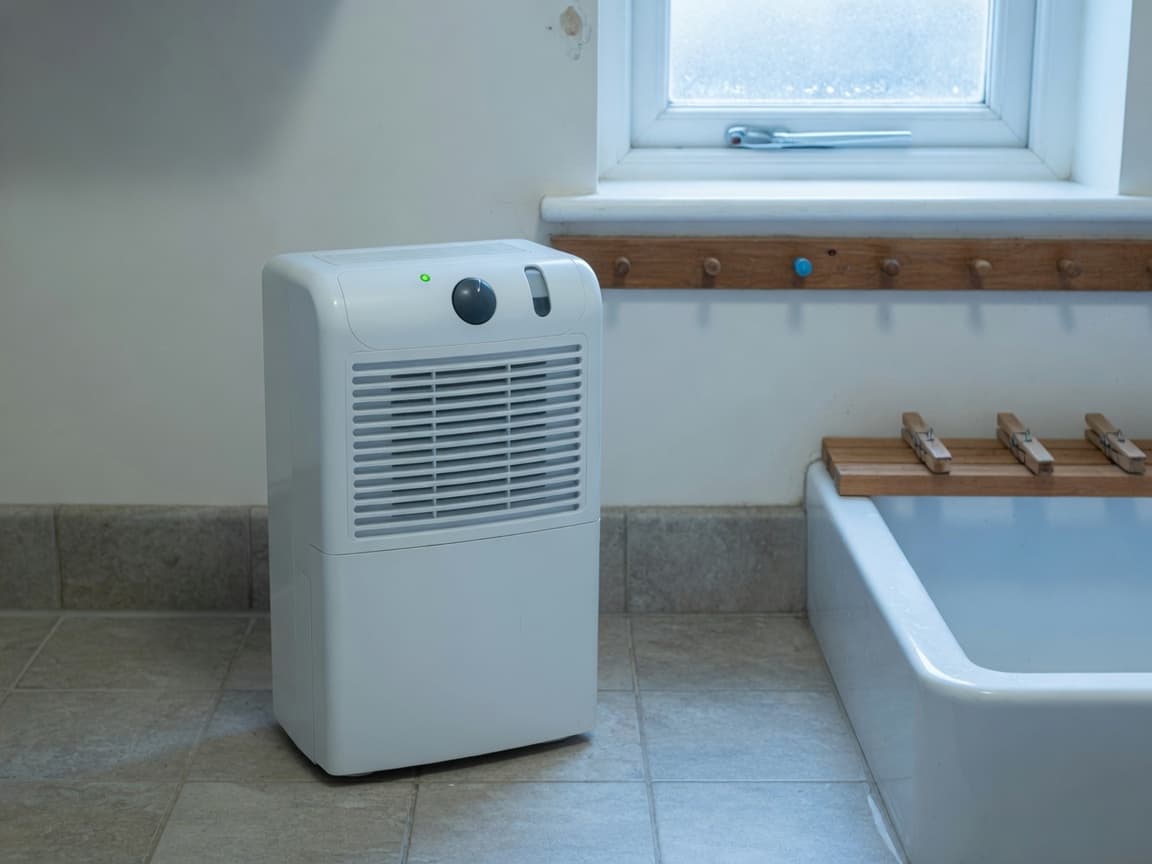
What we will not do on this site
We won’t invent a test we haven’t run. We won’t freeze a pound price as if Amazon never moved. We won’t give stars. Soft price bands in the data are a rough recent range, and every product page says so. The Amazon button is labelled See on Amazon, carries rel="nofollow sponsored", and it’s the only place a live price belongs.
Where to go next
- Meaco vs Pro Breeze 20L — quiet heated home or daily laundry and damp.
- MeacoDry Arete Two 20L — the 20 L class with the app and a faster laundry fan.
- MeacoDry Arete One 25L — the step-up for a large heated house.
- MeacoDry Arete One 12L vs Pro Breeze OmniDry 12L — the two 12 L compressors side by side.
- EcoAir DD3 Classic MK3 — the larger desiccant for a cold space.
- MeacoDry Arete One 10L — the quiet small-flat compressor.
- Russell Hobbs RHDH1061G Mini — a shelf or cupboard collector, not a room machine.
The method page is the short version of how the list was built. The Best 5 is five roles, and it’s not five trophies.